
behind-the-build
.jpg?width=1200&height=800&name=patrick-tomasso-Oaqk7qqNh_c-unsplash%20(1).jpg)

As a technology company, we try to stay at the cutting edge of development. So when we held our first-ever “PrayMore Innovation Day,” taking a whole day to explore new ways to improve our app, we naturally asked the question: “can AI be helpful in prayer?”
In Ecclesiastes 1:13, the Qohelet, or preacher, bemoans how wisdom in the world is meaningless.
“I applied my mind to study and to explore by wisdom all that is done under the heavens. What a heavy burden God has laid on mankind! I have seen all the things that are done under the sun; all of them are meaningless, a chasing after the wind.” (ESV)
The Qohelet finds that even a gift of God like wisdom is hevel: like vapor, temporary and hard to grasp. In many ways, today’s AI is the epitome of worldly wisdom. Large Language Models (LLMs) have compiled vast amounts of human knowledge and display it to us in an easy-to-consume manner. But we have also seen the problem of AI generating false information through hallucinations, sometimes called “AI slop.”
During our Innovation Day, we quickly identified that we can’t easily use generative AI, where the machine uses creative freedom to concoct something new, in prayer. Our aim at PrayMore is to encourage more direct conversations with God. Nothing should or can mediate prayer other than the Lord Jesus Christ himself.
However, AI can also be extremely useful for the kinds of things machines are good at. During our Innovation Day, we came up with a prototype tool that allows a person to enter a prayer and use the analytical power of AI to match the prayer request with relevant Scripture passages, classic prayers from history, and even an assessment of the person’s overall emotional state.
To do this, we constrained the LLM to only use data we fed it. We fed it all of the Bible, a book of Puritan prayers, and a list of commonly felt emotions. We then had the LLM categorize all of that data. Based on the categorization, the model was able to match relevant data to the user's input.
Here we see a user's prayer input:
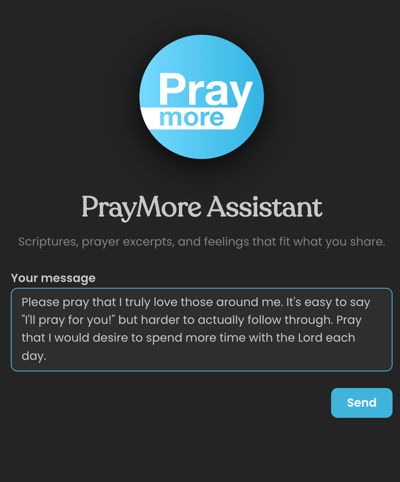
Followed by the suggestions:
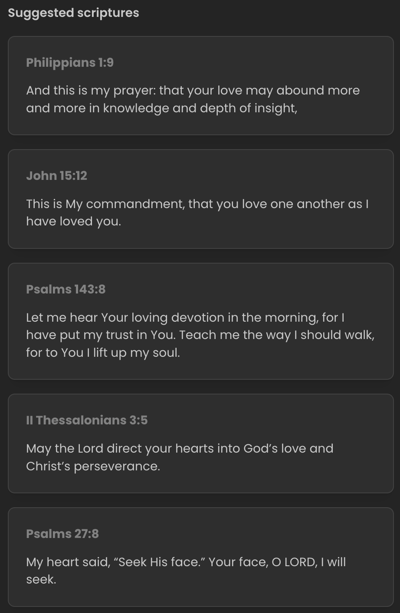
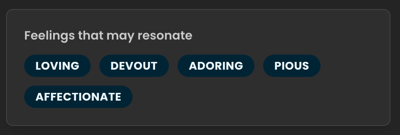
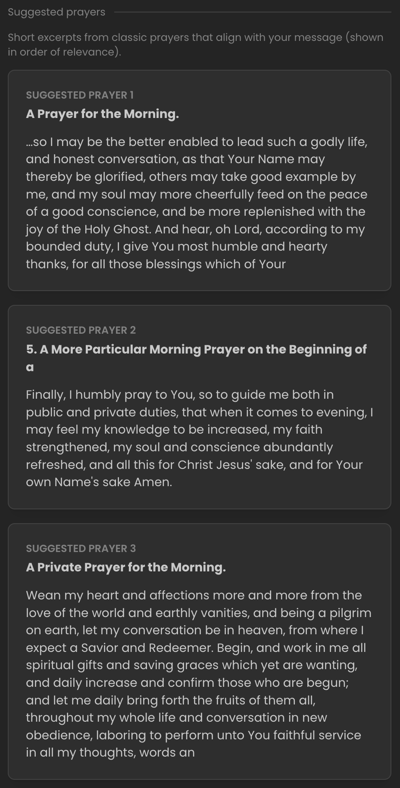
None of this is in our PrayMore app itself for now, but we had a lot of fun exploring and discovering the potential usefulness and the limitations of AI! What do you think? Would this kind of feature be useful to you in your prayer life?
Pray for us! Pray that we can continue to be good stewards of technology. Pray that we as Christians can be leaders in the world of technology
Thanks for praying. If you are reading this online or in your email and want to use PrayMore to pray for PrayMore (what a concept!!), the app is free, and we'd love for you to be blessed by it. You can even start your own Free Forever group in the app by inviting your friends.
Here are the three easy steps:
1. Click here to install the app on your phone.
2. Sign in with your Apple, Google, or Microsoft user.
3. Once you have signed in, click here to join the Pray more for PrayMore list.
Thanks for joining and praying like lives depend on it (because they do)!